Every blog belongs somewhere.
Current and subgroup linkage keeps long-form work inside the interest graph rather than detaching it into a separate publishing product.
Social product systems / product design
How do you build a social system when attention, access, and intimacy all need boundaries?
Nakupenda is an interest-graph social platform organized around Currents, with product-specific systems for messaging, community governance, long-form work, live audio, onboarding, and creator relationships.
OwnershipProduct design, interaction and state models, responsive UI systems, feature architecture, and implementation direction.
Context / attention
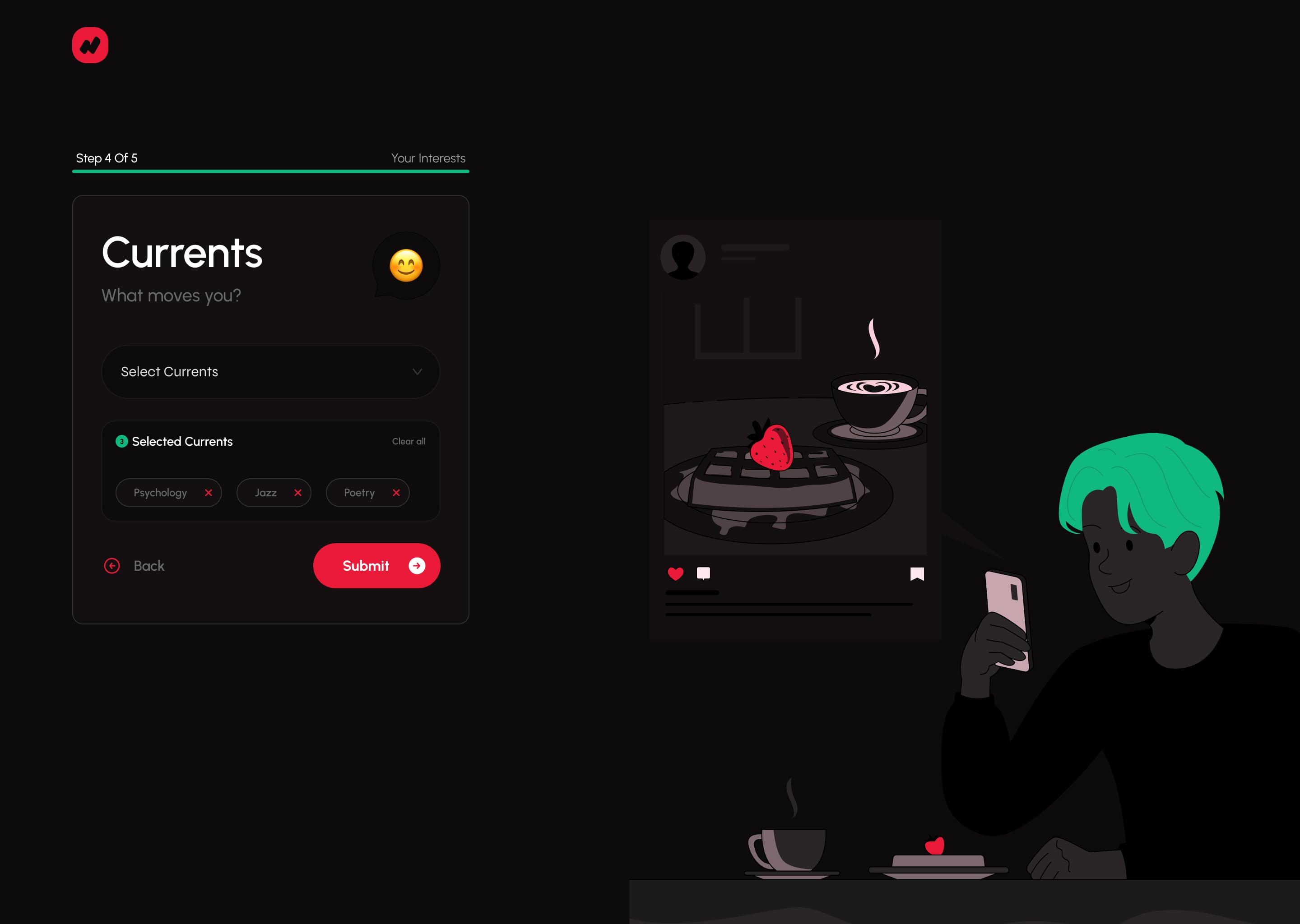
Nakupenda’s product source defines Currents as an explicit interest graph. People choose the spaces they want to participate in, and those choices shape onboarding, discovery, feed context, creation, and community identity.
This is a design decision about attention. Recommendation should be derivable from chosen context, not hidden behind a generic popularity loop.
TEXTin / boundaries
TEXTin is designed as relationship infrastructure rather than a generic message list. Conversation identity, privacy, message type, and access state belong to the thread.
After repeated unreplied messages, a receiver-configured boundary can make continued access explicit instead of allowing infinite social pressure.
Secret inbox and whisper-style messages require protected entry, hidden notification behavior, and predictable expiry.
The conversation can carry theme and aura state without replacing the core clarity of sender, receiver, and message status.
Boundary charging, AI memory, and shared spaces remain active-testing areas until their backend contracts are complete.
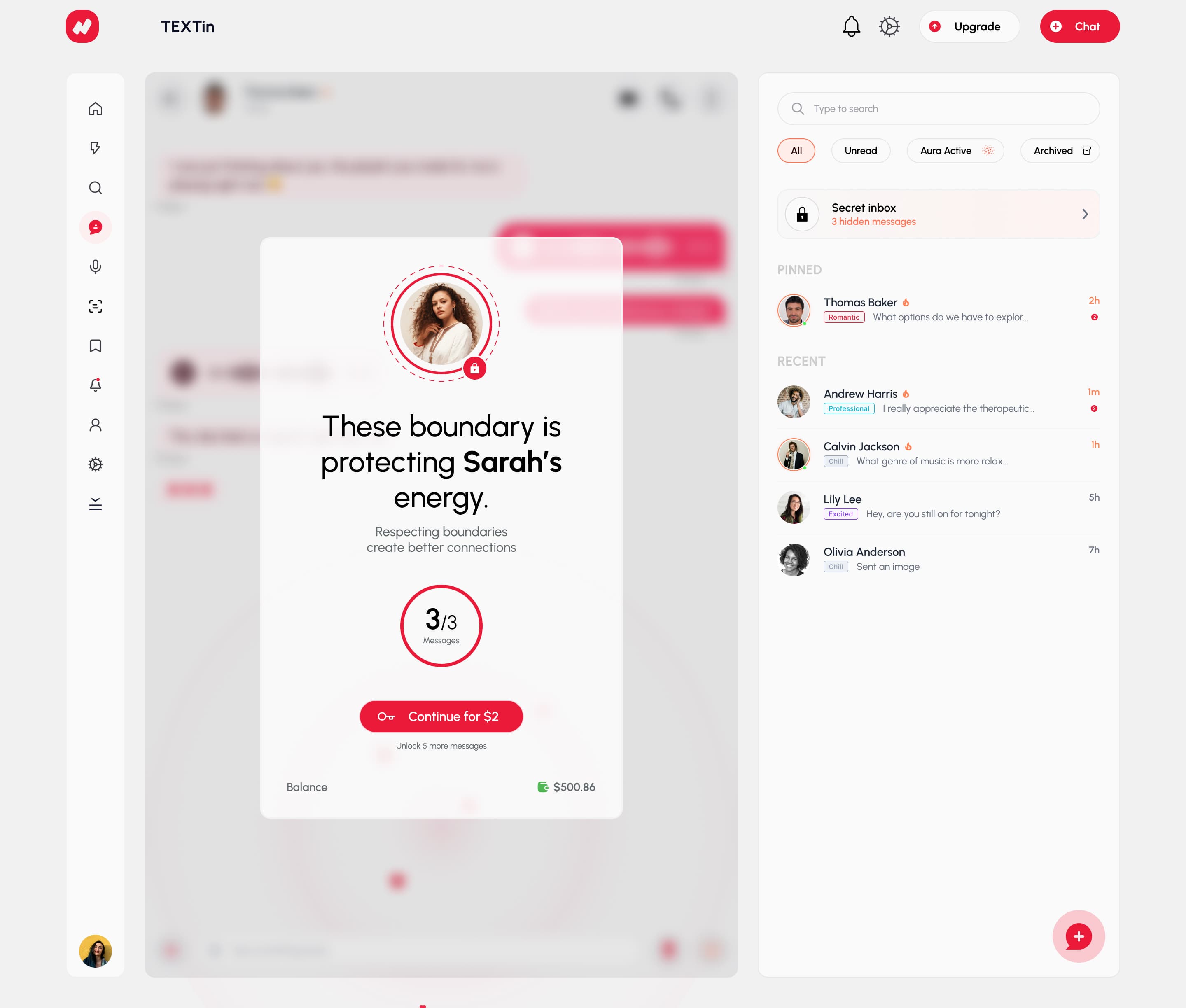
Access rules fail when they arrive as a surprise error. The interface should show who controls the boundary, why it exists, and what the next valid action is.
Whispers / realtime state
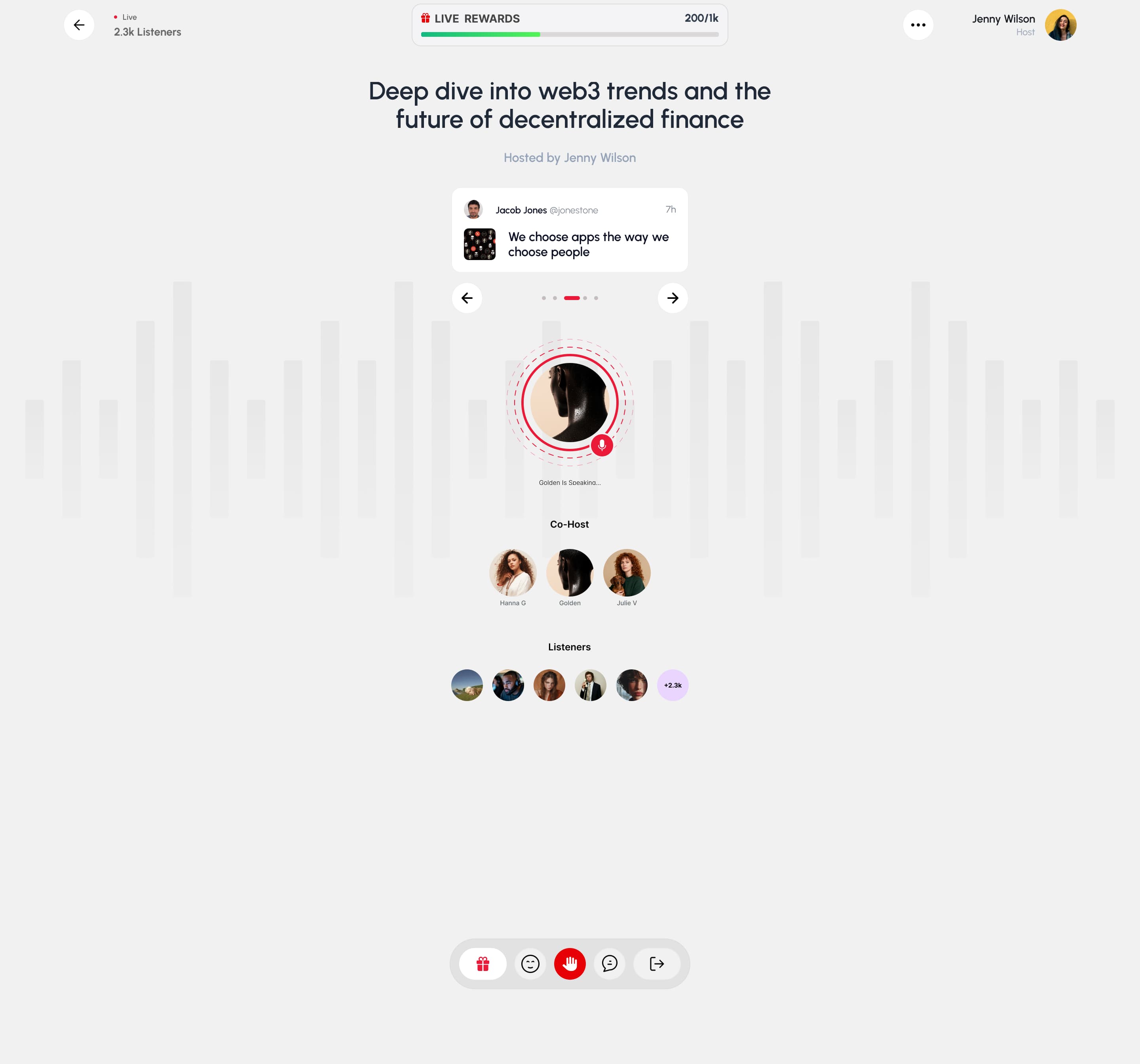
Whispers models ephemeral live rooms with explicit transitions between host, co-host, speaker, and listener. The UI separates moderation, stage control, speaking requests, gifting, listener rewards, and session retention.
Listeners can subscribe to room state, but publishing audio remains blocked until the role transition is approved.
| Role | Voice | Moderation | Rewards | Retention |
|---|---|---|---|---|
| Host | Yes | Owns room | Can receive | Can end and download |
| Co-host | Yes | Stage support | Can receive | Policy-bound |
| Speaker | On stage | No | Can receive | Session-bound |
| Listener | By request | No | Can gift / react | Session-bound |
The role-aware room UI is implemented. Some live payloads, gifting rules, snippet contracts, and retention mechanics remain incomplete backend work.
Community Control
Community Control gives members a structured way to review reported content, vote to keep or remove it, inspect the consensus, and enter an appeal path.
The product is intentionally more legible than opaque centralized moderation, but the current implementation is honest about contract gaps: the queue and skip flow are not fully backed, and appeal behavior still needs stable backend ownership.
A voting surface can make a decision inspectable, but abuse prevention, eligibility, evidence handling, and appeal rules still need deterministic ownership behind the interface.
Blogs / monetization
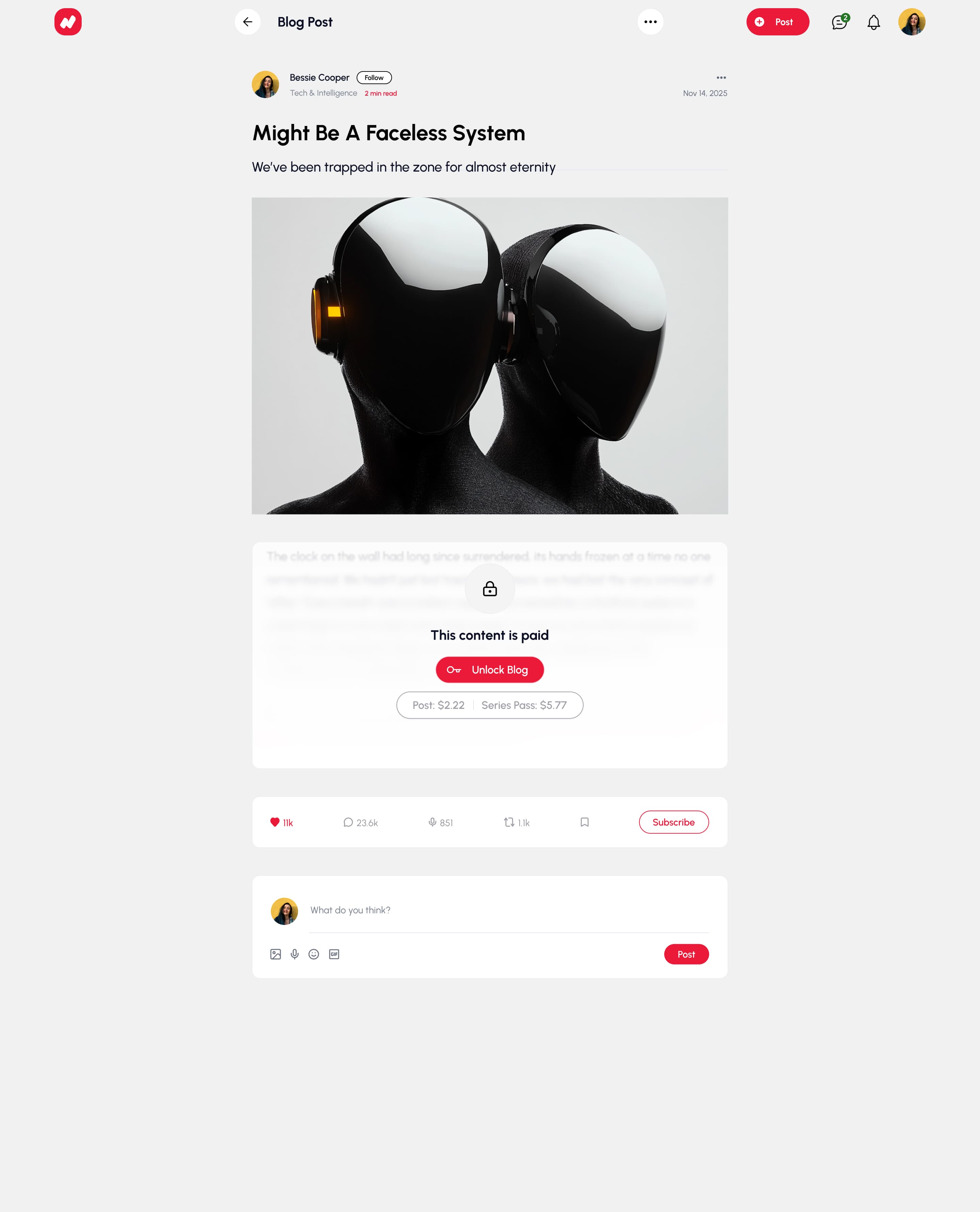
Current and subgroup linkage keeps long-form work inside the interest graph rather than detaching it into a separate publishing product.
Readers need a clear free boundary, locked continuation, and honest access state before monetization can feel fair.
Comments or entitlement hints can degrade without preventing the main article from rendering.
Versioning, collaboration, subscriptions, and voice comments remain planned until their APIs are verified.
Design system
A sharp operating typeface keeps dense social surfaces contemporary and compact.
The personal account accent identifies action and active state without spreading into every surface.
Business accounts receive a separate accent while shared components retain the same architecture.
Semantic background and text roles support dark mode without rebuilding the component system.
The implementation uses a 4px/8px spacing grid, semantic background and text tokens, responsive layouts, and server components by default. Product-specific state is allowed to be expressive; navigation and action hierarchy stay familiar.
Outcome / learning
Attention can be modeled as explicit user context through Currents.
Messaging UX improves when receiver-controlled boundaries and privacy states are first-class.
Live audio requires a role matrix, realtime transitions, and degraded states, not only an attractive room.
Community governance needs visible consensus and appeal paths, plus honest acknowledgment of incomplete policy contracts.
Screens are useful evidence only after the decision they prove is clear.